

Engineering Hope with 3D Printing and Soft Materials
While printing organs may sound like technology of the future, Associate Professor and Copenhaver Fellow in the School of Engineering Liheng Cai has created a method to do so using voxel bioprintin.
Voxels are the basic building blocks of the 3D world, just like pixels make up the 2D world. They can be thought of as Legos or blocks from the game Minecraft — the inspiration behind this method of bioprinting. Cai and his team have developed a method to use voxels made of polymers, chains of small molecules, to print biomaterials that mimic tissues.
“This is a totally new direction in the area of soft matter which people have rarely explored,” Cai said.
Voxel bioprinting involves placing droplets made of a polymer solution, which are the size of a human hair and the consistency of honey, in water without dissolving them. The droplets must then be picked up one by one and manipulated in a 3D space. All these steps are necessary to achieve tissue-like results.

By putting cell-instructive biomaterial droplets that house individual cells in a 3D space, you can control how that cell interacts with the new microenvironment and how it communicates with other cellsLCLiheng Cai
In the future, printed tissue mimics can help repair and generate new organs — which can be used for artificial transplants, studying disease progression and testing new drugs.
Cell friendly materials
One of the main challenges of creating biomaterials is ensuring that they can interact effectively with their environment.
“When you’re trying to make polymers cell-friendly, you have to modify the polymers to have some kind of handles, as they can’t really interface with surrounding micro binders,” Cai said.
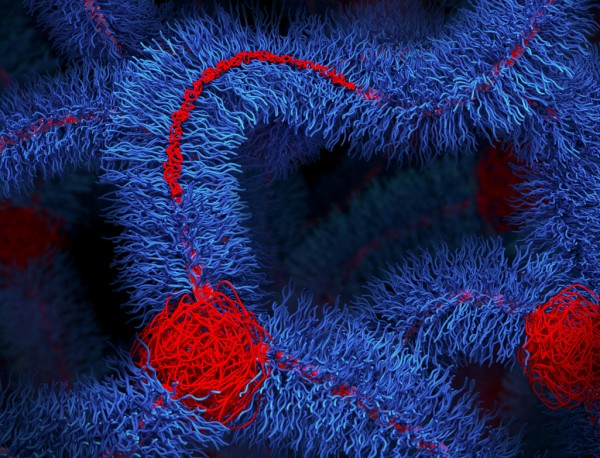
To tackle this issue, Cai and his team developed a polymer that resembles a bottlebrush. The bottlebrush polymer’s various arms serve as handles that allow it to interact with the cells around it and its flexibility and stretchiness enable it to form many connections at once.
Delivering therapeutics
Bottlebrush polymers are also effective for delivering therapeutics. For example, while the mucus of the lungs traps drugs and prevents them from being delivered to the cells, the bottlebrush polymer can easily penetrate the mucus with it’s snake-like form and deliver medication to the lungs.
“We want to find ways to help patients with mucus obstructive lung diseases,” Cai said. “The lungs are a very important organ — one of the major organs — so we have to be very careful.”
This method of delivery could help people with respiratory diseases, such as chronic obstructive lung disease and idiopathic pulmonary fibrosis, effectively receive medicine.
Solving key problems
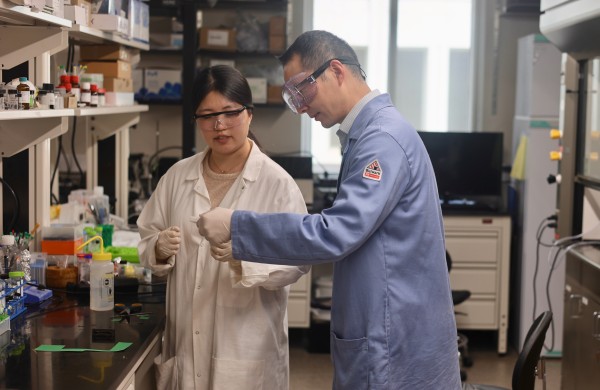
Helping patients is a staple of Cai’s research. He seeks to both increase fundamental knowledge in the fields of soft (bio)materials and polymer science, as well as put his work to practical use.
We work very closely with clinicians to identify problems that are important and could be solved, and problems that patients are looking for a solution to.
For his research, Cai won the Presidential Early Career Award for Scientists and Engineers and the Maximizing Investigators Research Award from the National Institute of Health.
This article was featured in our 2025 Annual Research Report. You can find the full report with more research stories here: https://research.virginia.edu/about/fast-facts/annual-report-2025