

How a Scientific Partnership Illuminates Cancer Immunotherapy
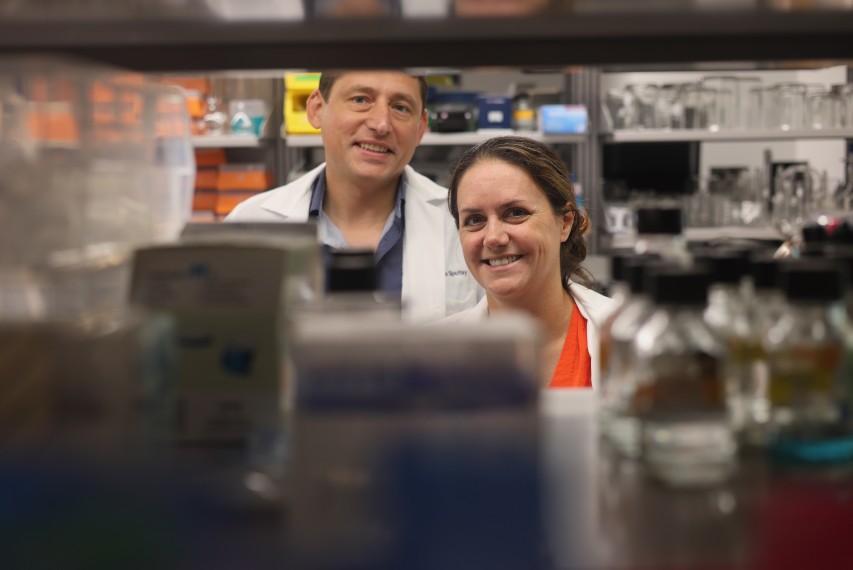
Professor Ilya Levental and Research Associate Professor Kandice Levental met on their first day of graduate school in 2003. During their time studying bioengineering, they both collaborated on projects and bonded over an interest in understanding how life works at a cellular level. In 2007, they got married and — five years later — started their lab.
We figured that we have a complementary set of expertise, so we started the [Levental] lab together 13 years ago nowILIlya Levental
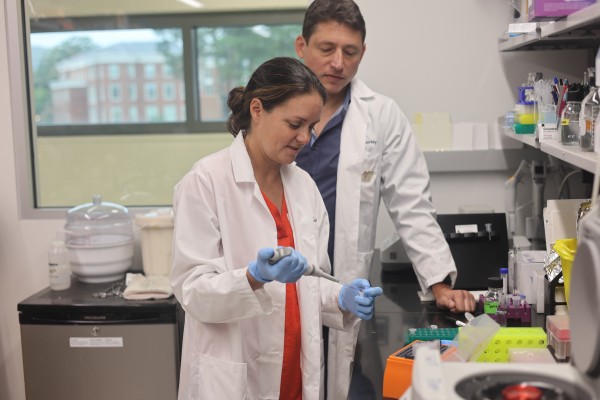
While Kandice Levental performs lab experiments and mentors students, Ilya Levental shares their work and looks at big-picture questions with trainees.
Unlocking How T Cells Recognize Cancer
The Leventals have identified a key mechanism by which T cells recognize cancerous cells. T cells detect and kill infected cells. This process, the Levental Lab discovered, is facilitated by the interaction between the cell membrane and protein condensates — cellular structures that organize cytoplasm.
“These are freely exchanging proteins popping in and out all the time, but such that if you were to take a snapshot, they look like they’re assembled,” Kandice Levental said.
The Leventals were the first to show that protein condensates organize the cell membrane to help T cells recognize infected cells.
What our study shows is that there’s a transduction across the membrane and an organization inside that says, ‘Yes, T cell, you are activeKLKandice Levental
This process, however, is not straightforward. “It’s not black or white. It’s not a ‘Yes’ or ‘No’ on signaling. There’s a tuning of which proteins can go into those lipid domains,” Kandice Levental said.
The National Institute of Allergy and Infectious Diseases has funded the continuation of the Leventals’ research, which is important for improving chimeric antigen receptors, or CARs — T cells modified to target a specific virus or cancer.
“This [research] wasn’t actually known when these first-generation and second-generation CAR T cells were being made,” Ilya Levental said. “That knowledge simply didn’t exist until our story.” These findings also support cancer immunology, a field that finds ways for T cells to target already developed tumors.
“Optimists in this field think that in the next 10, 15, 20 years, it could be that we will have completely licked cancer through cancer immunotherapy,” Ilya Levental said.
Opening New Chapters in Molecular Biology
With many questions still unanswered, the Leventals are energized by the potential of their research.
The best discoveries are the ones that don’t close a book, they open a book. You know, the first sentence or the first chapter,” Ilya Levental said. “We hope that this kind of stuff is something in that direction.
This article was featured in our 2025 Annual Research Report. You can find the full report with more research stories here: https://research.virginia.edu/about/fast-facts/annual-report-2025