


Beyond the Pain Scale: AI That Reads What Patients Can’t Say
Pain is one of the most difficult things to measure in a clinical setting. Patients cannot
always communicate it, and clinicians must often rely on observation alone. Cori Espelien, a postdoctoral researcher in UVA’s Department of Public Health Sciences, is working to change that with AI facial recognition software that can detect and classify pain automatically, opening new possibilities for patients who cannot easily self-report, including infants, people with chronic pain, and those in the midst of medical procedures.
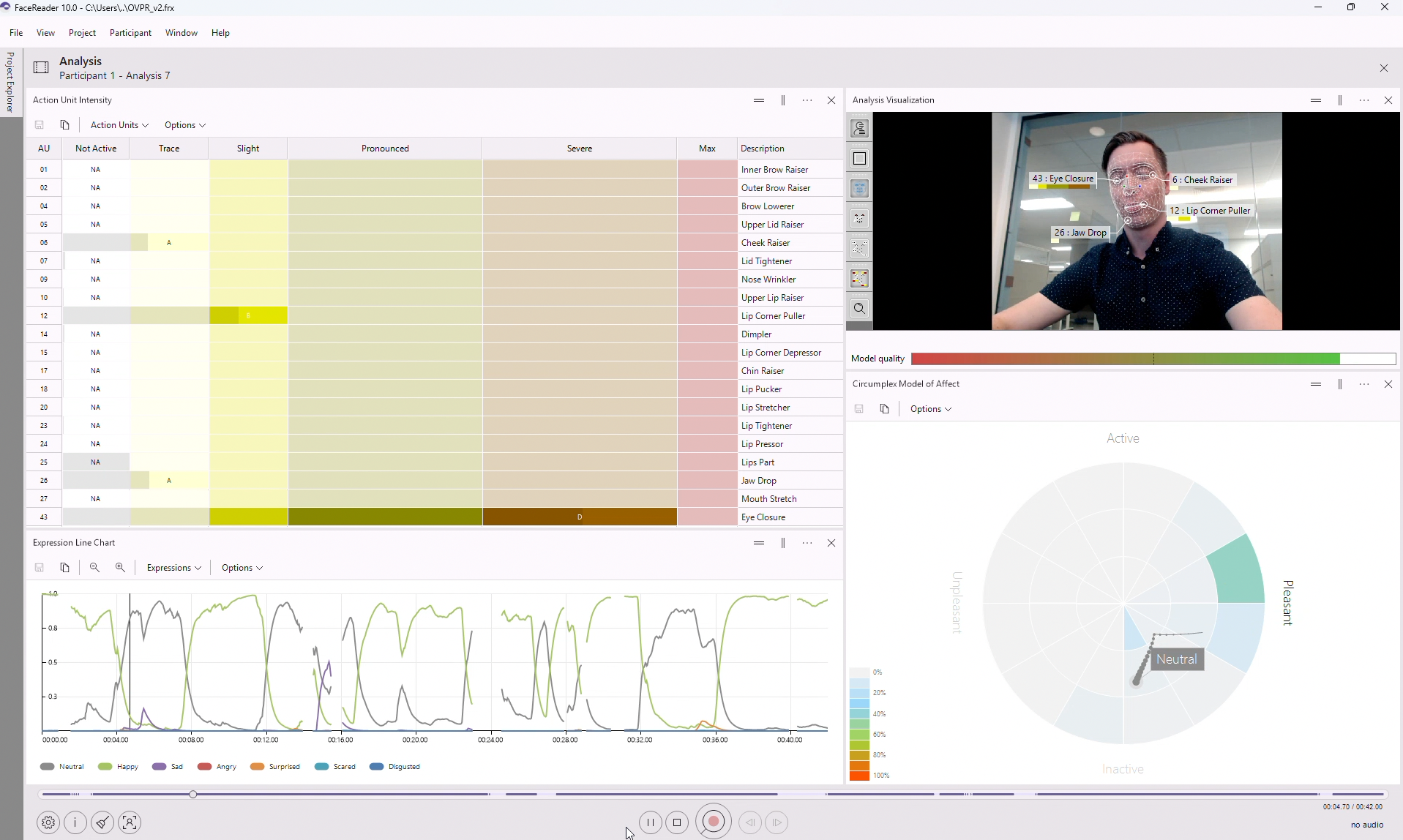
Espelien came to UVA after working in the medical device industry, drawn by the research at the Center for Applied Biomechanics (CAB), a lab focused on human motion and injury. During her PhD program in mechanical and aerospace engineering, she helped CAB implement a $1.2 million Department of Transportation grant to improve female crash test dummies for the National Highway Traffic Safety Administration. It was there that she first worked alongside Pavel Chernyavskiy, an assistant professor of public health sciences, whose facial coding software would eventually become the foundation of her current research.
After completing her PhD, Espelien moved into public health research, motivated by a desire to deepen her statistical skills and apply them to real clinical problem.
Being in public health, the statistical analytics really drew me in. I’m gaining fluency in the stats that are applied in machine learning.CECori Espelien
The research grew from an open-ended prompt. Chernyavskiy had used facial coding software in an earlier project and saw potential for new applications. “From a project with CAB, we had some videos, and he was like, ‘Why don’t you work on analyzing those and just seeing what’s there?’” Espelien said. What she found pointed toward pain detection, and the work has expanded from there.
Espelien is now focused on increasing the accuracy of her model and testing it in clinical settings. “I’m excited to have the opportunity to collect data in a real-world setting, see how our model does, and see how clinicians react to this type of technology in their space,” she said.
This story originally appeared in the 2026 Annual Research Report, produced by the Office of the Vice President of Research. Find more stories from this report here: https://news.research.virginia.edu/category/annual-report/
WHERE DISCOVERY HAPPENS
GET THE STORIES BEHIND THE RESEARCH
Receive updates about the discoveries, researchers, and ideas shaping our world — straight from UVA.
Video Transcript:
My research here in the Department of Public Health Sciences is looking at how we can use people’s expressions to tell us something about their emotional state, and that includes pain. We use videos of the face and measure how small muscle movements correlate to different pain states.
In this research, we see AI helping us actually detect the face of the individual, digitize the movement of that face, which generates these numeric muscle activations.
To demonstrate the concept, you can also dunk your hand in ice and see how your face can move in reaction to that stimulus. So there are several groups that we’re interested in helping. Pediatric or infant groups, people with dementia, or we’re also looking into people who are not conscious or able to communicate if they’re intubated, for instance.
If we can make an impact for the populations that cannot verbally provide a number, I see that as being some of the biggest impact potential that we can make.