Business

Environment

Your Thermostat Could Be Costing You More Than You Think

Extreme weather is straining the power grid, driven largely by residential heating and cooling habits. Darden professor Saed Alizamir analyzed granular smart thermostat data to reveal how automation and manual overrides affect energy use. His research suggests redesigning thermostats could cut costs, ease grid pressure, and help both consumers and the environment.


striped wave
Artificial Intelligence

AI Is Changing the Rules of Customer Data. Here’s What Wins Now.

AI is transforming customer data from a competitive asset into a prediction engine, says Darden professor Raj Venkatesan. Owning data isn’t enough—companies must convert it into customer knowledge through analysis. Success requires patience, cross-business insight application, and understanding three pillars: customer data, analytical capability, and the knowledge that analysis creates.

Farmer emptying a sack of freshly harvested cocoa pods onto a colorful pile on the ground at a cacao farm
Business

The Tipping Paradox: Why Sending Extra Cash Directly to Global Farmers Can Backfire

New research from the University of Virginia’s Darden School of Business reveals that blockchain-enabled consumer tipping for farmers can backfire. While the technology promises to send money directly to growers, a game-theoretic model shows intermediary firms may exploit tips as subsidies, cutting wholesale prices instead. A beneficial outcome requires moderately attractive farmer alternatives and sufficiently socially conscious consumers.

Illustration of a glowing digital brain with neural connections, symbolizing artificial intelligence and brain activity
Psychology

Good Disruption: Inside Brain-Computer Interfaces

Podcast

In this episode of Good Disruption, UVA Professor Jack Van Horn joins hosts Yael Grushka-Cockayne and Mike Lenox to explore brain-computer interfaces, a rapidly advancing neurotechnology that translates brain signals into action. From restoring movement and communication to bypassing damaged neural pathways, BCIs hold remarkable promise — alongside significant challenges — as the field moves from science fiction to reality.

Illustration of a metal toolbox with wrench tools on top, next to a construction hard hat
Artificial Intelligence

Want to AI-Proof Your Career? Buy a Boomer’s Blue-Collar Business.

MBA students are increasingly looking beyond tech startups to acquire “boring” blue-collar businesses like HVAC, plumbing, and landscaping firms. Darden professor Les Alexander explains why these businesses offer compelling fundamentals, AI disruption resistance, and strong growth potential — and how an unprecedented wave of Baby Boomer retirements is creating a rare window of opportunity for aspiring entrepreneurs through acquisition.

Extreme close-up of dandelion seed head, showing delicate white feathery filaments radiating from tiny seed points
Business

Beyond Public-Private Partnerships: The Power of Social Enterprises

Darden researchers Vidya Mani and Maya Stephens argue that including social enterprises in public-private partnerships can strengthen efforts to meet global development goals by bringing local knowledge, community trust and sustainable, revenue-generating solutions. Their research highlights successful partnerships in countries such as Ghana and Bangladesh, showing how collaboration among government, business and social enterprises can create lasting social impact at scale.

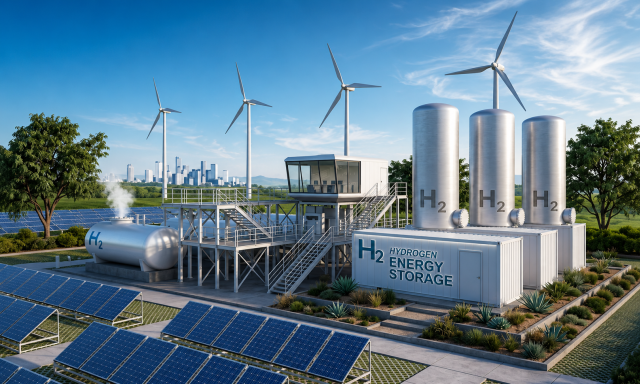
Hydrogen energy storage facility with H2 tanks, wind turbines, and solar panels near a city skyline
Environment

Why Long-Duration Energy Storage Could Be the Key to Grid Reliability

Podcast

When you think of energy storage what comes to mind? Batteries. But what if you need to store 1 GW of power (roughly 700,000 homes) over days, weeks, or a whole season? This is increasingly becoming a reality with an electric grid stretched by data center demand. Your traditional Li-Ion battery won’t cut it. It will require large-scale systems built to store and discharge massive amounts of energy on demand.