Astronomy

Astronomy at the University of Virginia combines access to world-class telescopes with innovative research initiatives spanning artificial intelligence, cosmic origins, galaxy evolution, and the search for life in the universe. Fueled by significant institutional investment and interdisciplinary collaboration, researchers are tackling some of astronomy’s biggest questions while providing students with hands-on opportunities typically found only at leading research institutions.
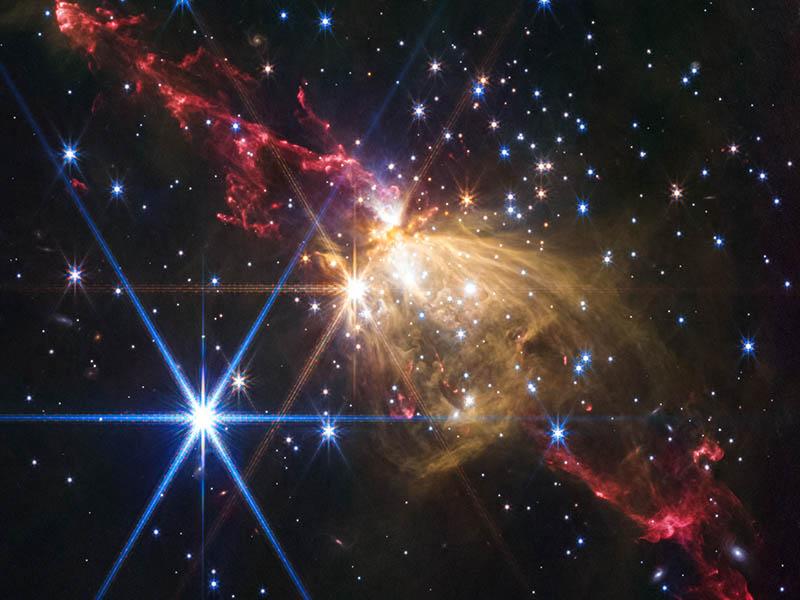
NASA's James Webb Space Telescope recently imaged an extremely large and symmetric protostellar jet at the outskirts of our Milky Way galaxy. Photo credit: NASA,
Infrared image of a star-forming cloud teeming with gas and dust, taken by NASA Wide-field Infrared Survey Explorer.
Astronomy

UVA Astronomers Contributing to NASA’s Plans for New Mission

NASA has advanced PRIMA, a far-infrared space telescope, into its next development phase, with UVA astronomers playing key roles. Professor Jason Glenn led the mission’s concept study, while Ilse Cleeves serves as co-investigator. Targeted for 2033 launch, PRIMA will explore planet formation, black hole growth and cosmic dust, marking UVA’s expansion into space-based astronomy.

Mojgen Aghakhanloo
Astronomy

Astronomers Solve the Mystery of ‘The Supernova Impostor’

UVA astronomer Mojgan Aghakhanloo and collaborators have uncovered the source of AT 2016blu’s repeated “supernova impostor” outbursts: a hidden neutron star or black hole siphoning material from the massive luminous blue variable star. Using Chandra X-ray observations timed to a predicted eruption, the team achieved the first X-ray detection of such a binary system.

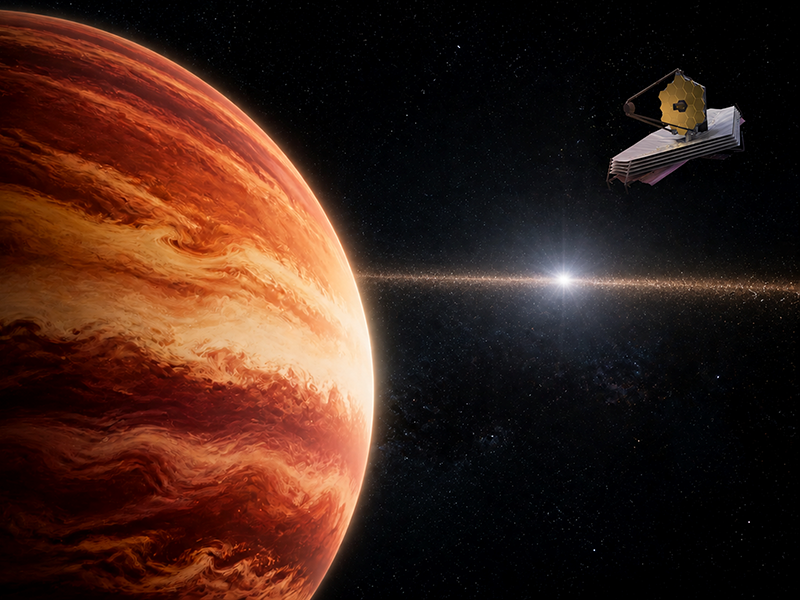
James Webb Space Telescope orbiting a large reddish-orange gas giant planet with a bright star shining in deep space
Astronomy

One Day on a Distant Planet Offers Clues to Its Origins

University of Virginia astronomer Yifan Zhou is leading the first direct measurement of a day on Beta Pictoris b, a super-Jupiter 63 light-years away. Using the James Webb Space Telescope, the team found the planet rotates every nine hours and spins in alignment with its orbit and host star, suggesting it formed gradually within a protoplanetary disk rather than through chaotic gravitational collapse.

Exploring the Universe
Astronomy

Exploring the Origins of the Universe

Kelsey Johnson, a professor of astronomy, is driven by a deep curiosity about the universe’s most fundamental processes. Her current research focuses on extreme star clusters, known as super star clusters. By analyzing how these clusters form, Johnson hopes to gain insights about the physical conditions of the early universe.