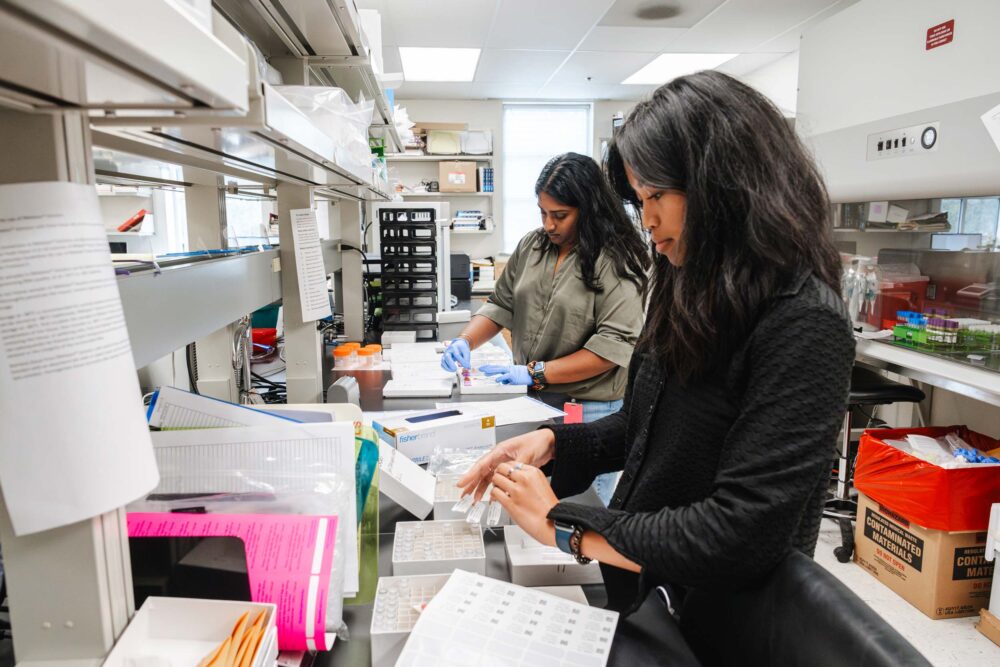
UVA researchers take malaria expertise from the lab to the field
Two doctoral students traveled to Angola to share techniques and learn from health professionals confronting the disease every day.
After 16 years of research and clinical testing, a School of Medicine diabetes expert has authored a book detailing how people with pre-diabetes or type 2 diabetes can manage their condition without the need for weight loss, insulin, medication or supplements.
Ferdinando Fioretto, a UVA Engineering computer science professor and researcher, will lead a project as part of the U.S. Department of Energy’s Genesis Mission.
A new UVA Health study reveals that calls to poison centers involving liver injuries from medications, supplements, alcohol, and other substances surged nearly 400% between 2000 and 2024. Acetaminophen was the leading cause, with suspected suicide the most common reason for exposure. Alcohol ranked second, with cases rising during the COVID-19 pandemic. Over 80% of cases required inpatient care.
University of Virginia astronomer Yifan Zhou is leading the first direct measurement of a day on Beta Pictoris b, a super-Jupiter 63 light-years away. Using the James Webb Space Telescope, the team found the planet rotates every nine hours and spins in alignment with its orbit and host star, suggesting it formed gradually within a protoplanetary disk rather than through chaotic gravitational collapse.
New research from the University of Virginia’s Darden School of Business reveals that blockchain-enabled consumer tipping for farmers can backfire. While the technology promises to send money directly to growers, a game-theoretic model shows intermediary firms may exploit tips as subsidies, cutting wholesale prices instead. A beneficial outcome requires moderately attractive farmer alternatives and sufficiently socially conscious consumers.
When people think about infectious disease outbreaks, it’s easy to focus on the pathogen itself. But according to researchers at the University of Virginia’s Biocomplexity Institute, understanding how diseases spread often has less to do with biology alone and more to do with the complex networks of people, places, and behaviors through which they move.
In this episode of Good Disruption, UVA Professor Jack Van Horn joins hosts Yael Grushka-Cockayne and Mike Lenox to explore brain-computer interfaces, a rapidly advancing neurotechnology that translates brain signals into action. From restoring movement and communication to bypassing damaged neural pathways, BCIs hold remarkable promise — alongside significant challenges — as the field moves from science fiction to reality.
Hannah Bako is an Assistant Professor at UVA’s School of Data Science, where she studies how people create and make sense of data through charts, graphics, and interactive visuals with the goal of making data more understandable for everyone.
GET THE STORIES BEHIND THE RESEARCH
Receive updates about the discoveries, researchers, and ideas shaping our world — straight from UVA.